Women Candidates in Elections: An Analysis of Party Ticket Distribution Following the Women’s Reservation Bill, 2023
Summary and Highlights
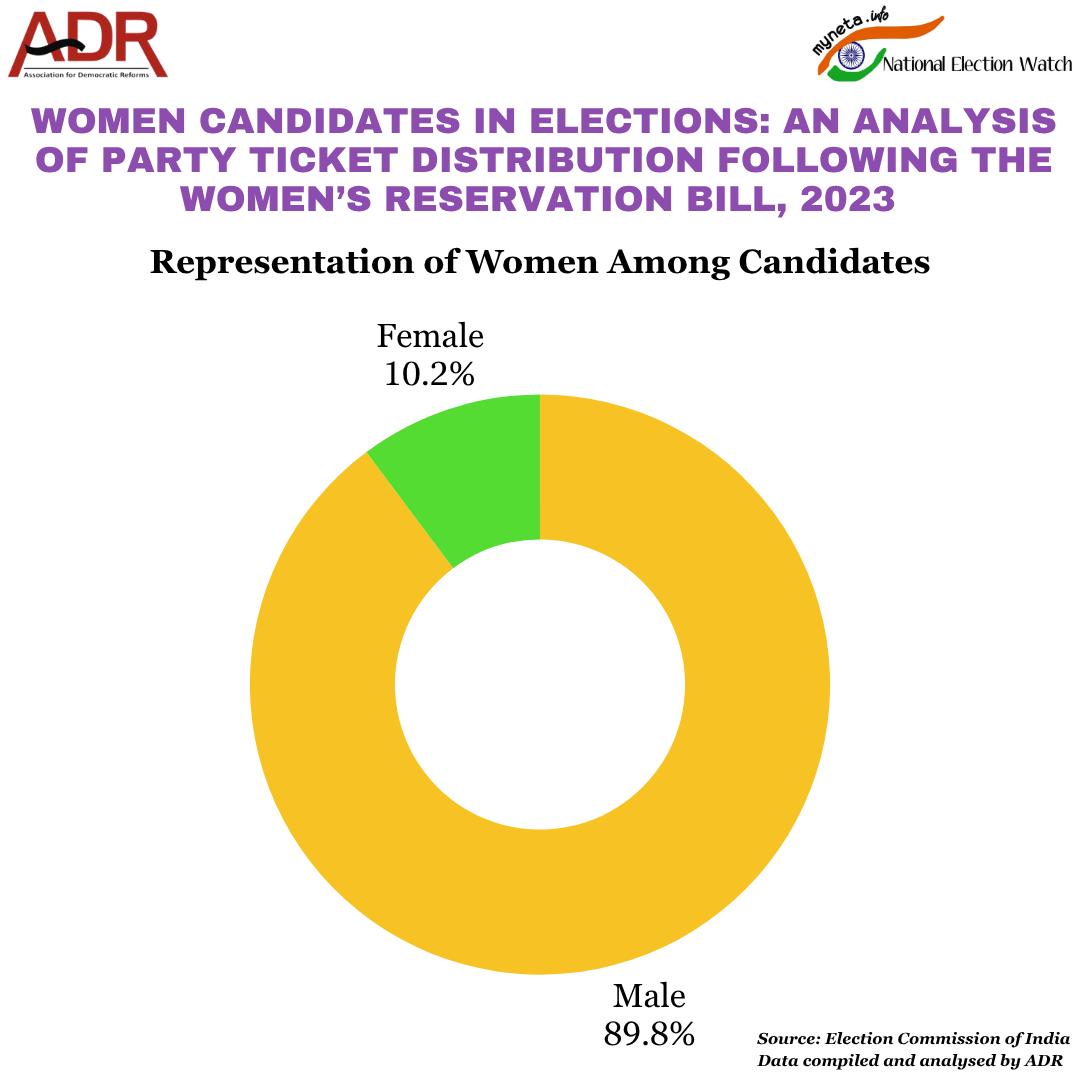
Association for Democratic Reforms and National Election Watch have analysed 39,789 candidates who contested in the Lok Sabha 2024 Elections and State/UT assembly elections held across the country after the passage of the Women’s Reservation Bill, 2023. Among them, only 4073 (10.2%) were women candidates.
Women's Reservation Bill 2023 was introduced in Lok Sabha on September 19, 2023. The Bill seeks to reserve one-third of all seats for women in Lok Sabha and State Legislative Assemblies. In this context, the report takes a look at participation of women in Parliament and State Legislative Assemblies, with a focus on trends following the introduction of the Women’s Reservation Bill.
Women Candidates in Lok Sabha Elections 2024:
- Following the passage of the Women’s Reservation Bill, 2023, the 2024 Lok Sabha elections were held. Out of a total of 8,360 candidates analyzed, only 800 (9.6%) were women.
- Out of 543 constituencies, 152 (28%) constituencies had zero women candidates.
Women Candidates in Current Assemblies:
- Following the passage of the Women’s Reservation Bill, 2023, assembly elections were held across 20 States and Union Territories (UTs). Out of a total of 31,429 candidates who contested these elections, only 3,273 (10.2%) were women fielded by political parties.
- States assemblies with highest percentage of women candidates: Odisha (2024) had the highest proportion of women candidates at 13.9%, followed by Delhi (2025) 13.7% and closely followed by Puducherry (2026) 13.6%. Across all State and Union Territory Assembly elections analysed, the proportion of women candidates did not exceed 14%. The 33% benchmark for female representation remains unmet under the current pattern of party ticket distribution.
- States Assemblies with lowest percentages of women candidates: Arunachal Pradesh (2024) and Jammu & Kashmir (2024) recorded the lowest participation of women candidates, with women constituting only 4.9% of the total contesting candidates.
Analysis of Ticket Distribution to Women Candidates by Political Parties - Election Wise
The data provides a clear analytical breakdown of female representation in candidate nominations by major National Parties and State (Regional) Parties across recent Lok Sabha and State Assembly elections.
Part I - Lok Sabha Elections 2024: (Focus: Parties with more than 20 contesting candidates)
Key Findings:
- None of the national parties met the one-third (33%) benchmark for women candidates in the 2024 Lok Sabha Elections.
- National Parties vs. Regional Trends: While BJP and INC fielded women candidates in the range of 13%–16%, several state parties recorded substantially higher levels of female representation. These included Naam Tamilar Katchi (50%), Biju Janata Dal (33%), Rashtriya Janata Dal (29%), and All India Trinamool Congress (25%).
- In the 2024 Lok Sabha Elections, only two state parties fielded 33% or more women candidates among their total candidates. These were Naam Tamilar Katchi (50%) and Biju Janata Dal (33%).
Part II – State and UT Assembly Elections:
Key Findings:
- This analysis covers 20 Assembly Elections held after the passage of the Women's Reservation Bill, 2023. Among the national parties, the Indian National Congress fielded 33% women candidates only in the Sikkim Assembly Election.
- Among the state parties, Naam Tamilar Katchi contested the Puducherry and Tamil Nadu Assembly Elections and fielded 50% women candidates in both elections. In addition, CPI(ML)(L) fielded 56% women candidates in the West Bengal Assembly Election and 33% in the Assam Assembly Election. Samajwadi Party fielded 40% women candidates in the Rajasthan Assembly Election. Viduthalai Chiruthaigal Katchi fielded 50% women candidates in the Puducherry Assembly Election, while the Rashtriya Lok Janshakti Party allotted 50% of its tickets to women candidates in the Delhi Assembly Election.