Political parties, for their part, are not neutral actors in this process. The preference for financially self-sufficient candidates reduces campaign costs and increases electoral competitiveness.
In The Great Gatsby, F. Scott Fitzgerald writes of a world where wealth does not just buy comfort, it buys entry, proximity, and power. Assam’s 2026 assembly elections suggest something similar about contemporary politics: wealth is no longer incidental to democracy; it is increasingly its entry ticket.
The numbers are difficult to ignore. Eighty-five per cent of Assam’s MLAs are crorepatis even though only 39% of candidates fall in that category. This is not merely a statistic; it is a pattern. And patterns, in politics, reveal structure.
Begin with the electoral outcome itself. The BJP’s emphatic victory, 82 seats in a 126-member assembly, consolidates its dominance in the state. But beneath this consolidation lies a quieter transformation. Assam’s political field is not just being reorganised along ideological or organisational lines; it is being reshaped along economic ones.
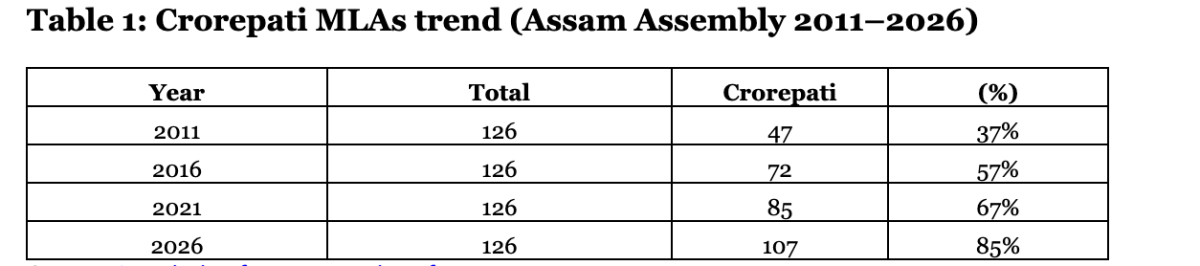
Before turning to the figures, it is worth noting that changes in the composition of legislatures often unfold slowly, reflecting broader social shifts. What we see here, however, is far sharper. Table 1 tells us that the proportion of crorepati MLAs has risen from 37% in 2011 to 85% in 2026. This is not a gradual transition; it marks a clear structural break. Within a decade, the assembly has moved from being socio-economically mixed to overwhelmingly affluent.
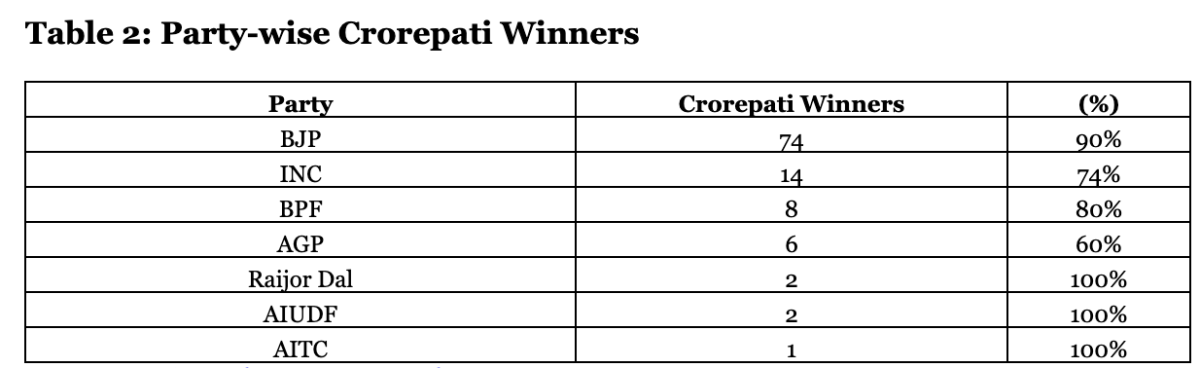
Before looking at the party-wise figures, it is important to recognise that this concentration of wealth is not confined to any one political formation. Ninety percent of BJP MLAs are crorepatis (Table 2), while the Congress stands at 74%, and regional parties like the BPF and AGP also exhibit similarly high concentrations. Even smaller parties report near-total dominance of wealthy candidates. The pattern, then, is not ideological, it cuts across party systems.
What explains this? Part of the answer lies in how Assam’s politics has evolved over the past decade. The BJP’s consolidation has been built on a broad coalition, upper castes, sections of OBCs, tea tribes, and segments of Assamese sub-nationalist sentiment. Regional parties like AGP and BPF have been absorbed into this broader framework, while the Congress has struggled to maintain a coherent counter-coalition. Yet, across these shifts, one feature remains constant: candidate selection increasingly favours those who can mobilise substantial financial resources.
This becomes clearer when we examine the distribution of wealth.
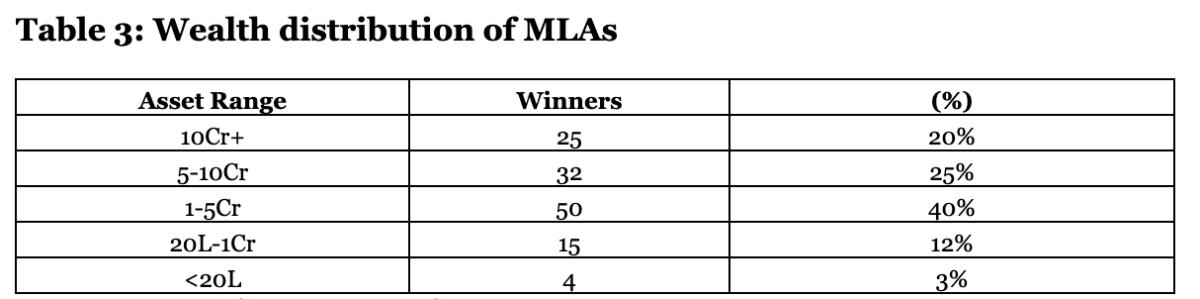
Before turning to the distribution itself, it is worth noting that any representative body ideally reflects the economic diversity of the society it serves. What emerges here, however, is far from balanced. Figures in Table 3 tell us that 45% of MLAs have assets above Rs 5 crore, including 20% above Rs 10 crore. At the lower end, only 3% have assets below Rs 20 lakh, and just 2% fall below Rs 1 crore. In a state where large sections depend on agriculture, informal labour, and tea plantation work, this concentration raises a fundamental question: who does the assembly represent?
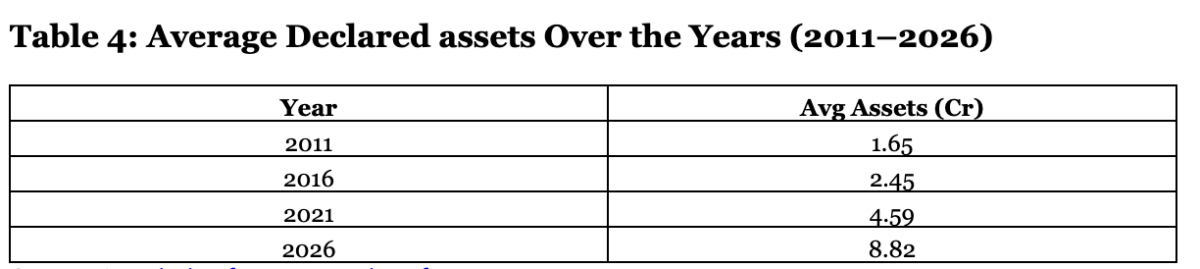
Placed within a longer trajectory, the shift becomes even more striking. The data indicates that the average assets per MLA have risen from Rs 4.59 crore in 2021 to Rs 8.82 crore in 2026 (Table 4), marking a near doubling within a single electoral cycle. This is not merely an upward drift but a sharp escalation, suggesting that the financial stakes of electoral competition have intensified significantly in a short span. As the average wealth required to remain competitive increases, so too does the informal threshold for entry, making elections progressively more resource-intensive and narrowing the field of viable participants.
At the other end of the spectrum, the contrast is even more telling.
Only three MLAs, around 2% of the assembly, have assets below Rs 1 crore. This is not simply a case of uneven distribution; it points to a near absence. When such a small fraction of representatives come from relatively modest economic backgrounds, it suggests that entry into politics is no longer broadly accessible. Instead, it is increasingly filtered through financial capacity. Those without access to capital, teachers, small traders, grassroots organisers, find it harder not only to compete, but even to enter the fray. What emerges, then, is not just inequality within the assembly, but a narrowing of the very pipeline through which representation is produced.
The implications extend beyond entry into politics; they shape continuity as well.
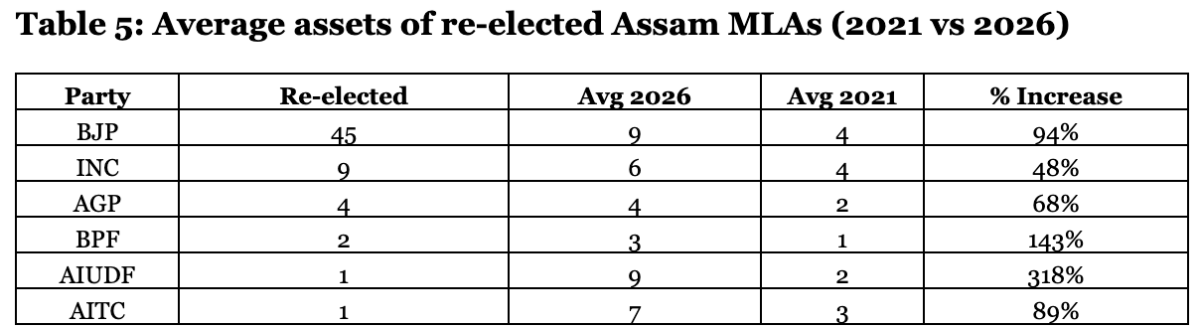
Seen over time, the pattern becomes even more pronounced among those who return to office. The re-elected MLAs witnessed an approximately 80% increase in assets, rising from Rs 4.17 crore in 2021 to Rs 7.52 crore in 2026 (Table 5). This suggests that political office does not merely reflect existing economic advantage, it can actively reinforce it. Incumbency, in this sense, is not just about visibility or organisational strength; it also brings access to networks, influence, and opportunities that can further consolidate wealth. Over successive terms, this creates a compounding effect, where those already advantaged are better placed to strengthen their position, both politically and economically.
This creates a self-reinforcing cycle: wealth enables entry, entry enables power, power enables further wealth, and accumulated wealth enhances the probability of re-election.
In Assam, this cycle interacts with existing social structures in complex ways.